It is a renewable organic substance of animal or plant origin. We must not forget that not long ago it was the most important source of energy, since manufacturing activity was based on it until the beginning of the industrial revolution. After the appearance of fossil fuels, the use of this type of renewable energy gradually decreased until it almost completely disappeared.
Its energy content comes from the solar energy captured by plants in the process of photosynthesis and accumulated in the bonds of the organic molecules that make them up. The use of this energy consists of taking advantage of organic materials of animal and plant origin and products derived from human use, that is, reusing urban solid waste, agricultural, forestry, industrial waste, etc.
The current high price of fossil fuels, in addition to the known damage they pose to the environment, mixed with the continuous technological advances that have occurred over recent years, have generated systems that are increasingly more efficient and, above all, cleaner, so that what is known as bioenergy is becoming increasingly important and is increasingly presented as a possible alternative to the until now widespread use of fossil fuels.
We understand how natural biomass that which comes from a previous transformation process, for example firewood obtained directly from the trunk of trees used to generate heat, cold or electricity, we can find it in different states:
- Solid: pellets, briquettes or chips
- Liquid: biodiesel or bioethanol.
- Gaseous: biogas.
Currently we can find systems of dry residual biomass, understanding it as that coming from forestry processes and waste from wood processing industries, in its application to buildings, such as boilers or pellet stoves. They are usually placed in series, that is, in parallel using the number that is necessary according to the energy demand of the building. The so-called pellets are compacted wood chips; wood chips, olive pits or firewood are also used, being the most common raw materials used by these systems. This type of wood is usually obtained from plants such as willow or poplar, which are short rotation trees.
However, materials such as cereal husks and straw can be used as fuels derived from cereals. They are raw materials in solid form, but we can also find oils such as sunflower oil that are converted into biodiesel. It can also be obtained in gaseous or biogas form, using liquid manure in combination with cereals, for example corn.
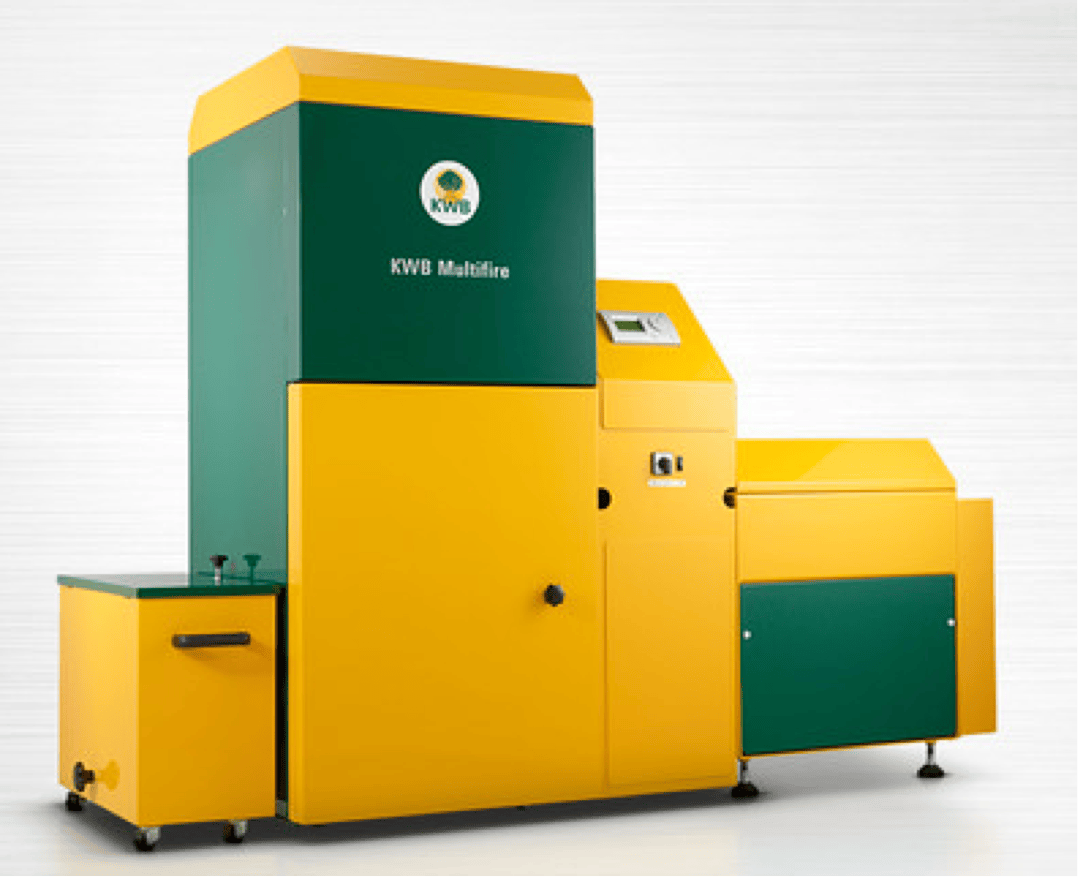
Image: KWB wood chip, pellet and olive pit boiler. Source: kwb.es
The fact that by-products are used is the key to the growth that this type of systems is experiencing in the immediate present, it means maximum use of resources. An example that allows us to appreciate more clearly this total use is the use of olive pits as a source of energy. A research project is currently being developed for the development of advanced fractionation and biological conversion processes to obtain energy and chemical products from olive pruning presented in the last “Biomass Conference and Exhibition”, which would further achieve the objective of complete use in olive manufacturing.
Special attention must be paid to the subsequent treatment of the ashes generated after the combustion process. Currently, they can be used as a filler for ceramic materials or as an additive in the manufacture of cement. Researchers from the University of Navarra are carrying out studies for their application even as fertilizers.
The Biomass is compatible with:
- Solar thermal (sized for DHW), the boiler would cover the heating.
- Photovoltaic.
- Wind.
- Geothermal. The boiler would cover DHW and part of the heating. Geothermal would cover the rest of the heating. This case is incompatible with thermal panels.
- Absorption chiller (solar cooling). The boiler would cover the heating. The thermal panels cover DHW and provide heat to the chiller.
- Cogeneration. Cogeneration covers ACS. The boiler covers the rest of the heating.
Biomass is not totally incompatible with any technology. It is likely that a traditional auxiliary boiler will be required for possible contingencies. It is very important to plan well the space for delivery, fuel storage as well as the removal of ashes.