As we have seen previously, the soil has a great thermal inertia, this means that the temperature inside it at a certain depth is constant throughout the year. An example where this phenomenon can be seen is in caves. The soil temperature will always be lower than the ambient temperature in summer and higher in winter, however, depending on the depth and composition of the soil, this temperature damping may be of greater or lesser magnitude.
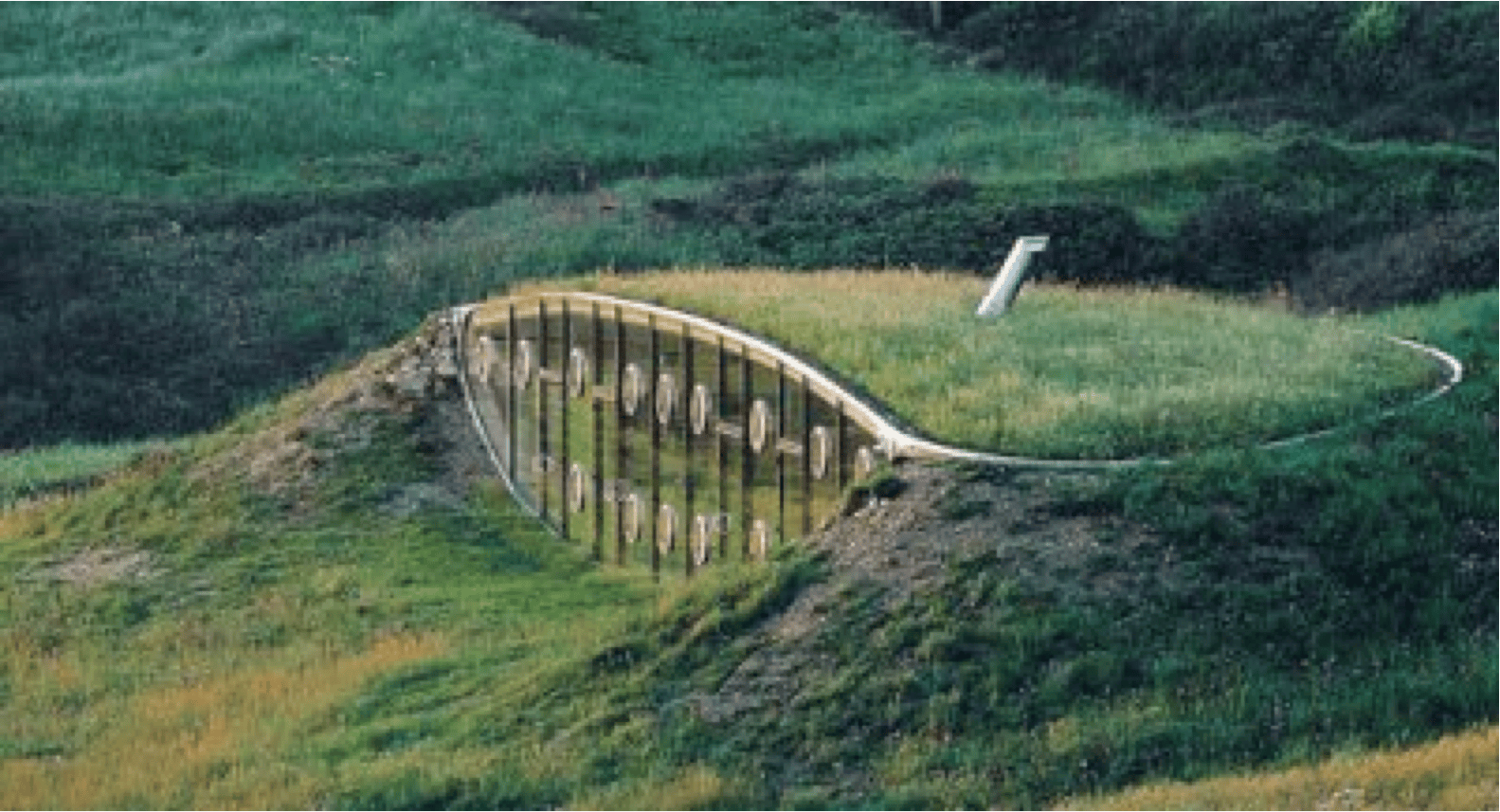
Image: Example of taking advantage of the thermal inertia of the soil. Source: vilssa.com
This variation in temperature due to the thermal inertia of the ground can be seen in the lower rooms of the buildings, in the basements for example the temperature during the summer is considerably lower than outside, however the relative humidity is much higher, as is the scarcity of natural light. These would be the two major drawbacks to building completely buried buildings.
Despite the disadvantages, this does not mean that it is not feasible. Semi-buried systems can be used in which a slope facing south allows the north façade to be kept semi-buried or completely buried. By adding adequate ventilation systems and a glazed surface on the south façade we could achieve the desired lighting and reduce humidity.
When applying this principle we can opt for different construction solutions that provide us with an improvement in the efficiency of our building. We can partially bury the enclosures that do not have enough solar radiation or place a layer of earth on the cover that will provide extra insulation. This overload must be considered in the sizing of the structure.